
August 2026
You don’t have to be an athlete to benefit from a strong core. Strong core muscles give you the stability you need for everyday activities like climbing stairs, lifting groceries, getting up from a chair, or carrying a child. Core strength can also support better posture, balance, and sports performance — and may reduce your risk of injury.
The good news: You can build core strength at home without a gym membership or fancy equipment. Read on to learn what the core muscles are, why core strength matters, and how to strengthen your core with five beginner-friendly exercises.
What are the core muscles?
Many people think “abs” are the only core muscles. In fact, the core includes muscles throughout your torso that help keep your body stable and balanced.
Core muscles include:
- The muscle groups people typically think of as the “abs” — the transverse abdominis, the rectus abdominis, and the obliques
- The pelvic floor
- The hip flexors
- The diaphragm
- The multifidus and erector spinae (long muscles that run along both sides of the spine)
- The lower back muscles
Not sure where these muscles are located? Live Science has some helpful illustrations of all the core muscles.
What happens if your core isn’t strong?
Poor core strength can contribute to a range of issues, including:
Back pain. A weak core can make it harder to support the spine. An estimated 70% to 85% of people will experience low back pain at some point. When core muscles are weak, they can’t adequately support your spine. As a result, the muscles in your lower back may compensate and take on more load than they can handle — leading to strain, fatigue, or chronic pain.
Increased fall risk. Older adults with persistent low back pain — often a sign of core weakness — are 54% more likely to experience a fall than those without it. Core strength also supports balance: A strong core keeps you stable when you shift your weight, change direction, or navigate uneven surfaces, all of which are key to preventing falls.
Joint pain and injuries. A weak core is a risk factor for joint pain and lower-extremity injuries — the hip, knee, ankle, and foot. That’s because the core stabilizes the pelvis. When the pelvis isn’t stable, it can affect alignment all the way down the leg.
Poor posture. Your core muscles help hold your spine upright throughout the day. When they’re weak, your body may compensate by leaning forward or slumping, placing extra stress on your spine, neck, and shoulders. Over time, poor posture can contribute to chronic pain and stiffness, making it harder to stand or sit comfortably for extended periods.
5 core exercises you can do at home
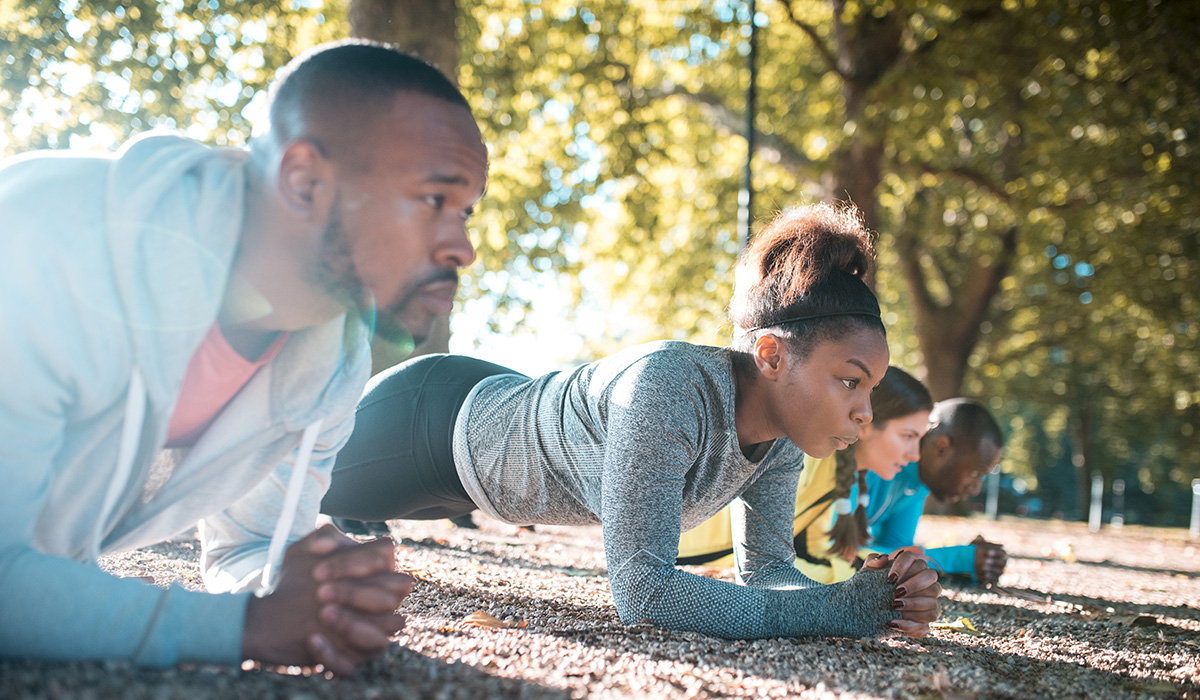
- Plank. With just your toes and forearms on the floor, hold your body parallel to the floor, keeping your hips level.
- Too challenging? Start on your knees instead of your toes.
- Need more challenge? Hold for a little longer every time. Plank targets the entire core, including deep stabilizing muscles.
- Dead bug. Lie on your back with arms pointed at the ceiling and knees bent at 90° (calves parallel to the floor). Slowly lower one arm and the opposite leg (unbent) toward the floor. Return and then switch sides. Dead bugs are great for building core stability and coordination.
- Bird dog. On all fours (palms and knees/calves), extend one arm and the opposite leg simultaneously, hold briefly, then return. Like dead bugs, bird dogs are a low-impact way to build overall core strength and stability.
- Bridge. Lie on your back, feet flat on the floor, then drive your hips upward by squeezing your glutes. Bridge engages the glutes, lower back, and pelvic floor — the often-neglected posterior core that’s just as important as your abs.
- Bicycle crunch. Lie on your back with your hands behind your head and your knees bent at 90° (calves parallel to the floor). Lift your shoulders off the floor. Bring one knee toward your chest while rotating your opposite elbow to meet it. Straighten the other leg as you twist. Alternate sides with a slow pedaling motion.
The American Council on Exercise ranks the “bicycle maneuver” as the best exercise for strengthening the rectus abdominis muscles (the two muscles that run vertically down the center of your abdomen) and the second best for strengthening the obliques (the muscles along the sides of your torso that control rotation and lateral bending).
What if you need help learning core exercises?
If you’re just starting out, need a refresher, or prefer to work out with guidance or a group, here are some options to try:
Pilates. Pilates focuses on strengthening all the core muscle groups. It’s a good option for beginners and those recovering from injury, since most instructors emphasize slow, controlled, precise movements — and proper form over speed or intensity. Look for Pilates classes at dedicated studios, yoga studios, local gyms and fitness centers, and community centers.
Yoga. While you might think of yoga more for flexibility and stress management, many yoga classes also include a meaningful amount of core work, including plank and bridge. Instructors will often cue you to “engage your core,” “draw your navel in,” or “lift the pelvic floor” to support a variety of moves. This can help you develop a better sense of how to activate those muscles outside of class.
Group strength-training classes. Many gyms, studios, and community centers offer more beginner-friendly strength-training options. Look for classes like “circuit training” or “functional fitness.” Most strength-focused classes often include core work.
Personal trainer. Don’t like the group setting, or need more personalized instruction? Schedule a few sessions with a personal trainer at a local gym. One-on-one instruction can help you learn to perform common core exercises safely and correctly.
Physical therapist. If you are managing an injury, ask your doctor if seeing a physical therapist might be right for you.